When Your GE Appliance Quits: What's Usually Wrong and What to Do Before You Call a Repair Tech
It always happens at the worst time. You’ve got a full hamper and a washer full of standing water. Or guests are coming over and the dishwasher is just humming at you. Or you open the fridge and the milk feels a little too warm.
GE appliances are well built, and most of them last for years. But they’re machines, and machines wear out. The good news is that the problem is often smaller than you’d expect. At Staunch Appliance Pro we see the same handful of issues again and again, so here’s a rundown of what usually goes wrong with each appliance and what you can safely check yourself.
Washer trouble:
If you’re searching for General Electric washer repair, chances are it’s one of three things: it won’t drain, it won’t spin, or it’s leaking.
A washer that won’t drain is usually blocked. Coins, hair ties, and the odd sock love to find their way into the drain pump. Before anything else, check that the drain hose isn’t kinked behind the machine. If the hose is fine and water still sits in the drum, the pump probably needs attention.
A washer that won’t spin is often a simple overloaded or lopsided load. If it still won’t spin with a small, balanced load, the cause could be a worn belt or a bad lid switch on a top-loader.
Leaks are trickier, since water can come from the door seal, the hoses, or the inlet valve. Don’t keep running the machine while you work it out, because slow leaks can damage your floor. Good GE washing machine repair is mostly about finding where the water is really coming from, and that takes a trained eye.
One more thing: front-loaders can get a musty smell around the rubber door gasket. Wipe it down and leave the door cracked open between loads. It makes a bigger difference than you’d think.
Dryer problems:
Most GE dryer repair calls come down to heat, or the lack of it. If the dryer tumbles but your clothes stay damp, the heating element (on an electric model) or the igniter (on a gas model) may have failed. A blown thermal fuse can cause the same thing.
But before you book anything, clean the lint trap and look at your vent hose. When a dryer takes two cycles to dry a load, a clogged vent is the culprit more often than a broken part. It’s also a real fire risk, so don’t ignore it. If you ever smell something burning, stop the dryer and call someone.
Squealing or thumping usually means worn drum rollers or a tired belt. It won’t fix itself, and the noise tends to get worse.
Dishwasher problems:
When a dishwasher stops cleaning well, people assume the motor is dying. Usually it isn’t. Pull out the bottom rack and check the filter. You’ll often find a layer of gunk that’s been building for months. Check the spray arms too, since the little holes clog with food and mineral deposits.
If you still have a puddle at the bottom after a cycle, look at the drain hose and the garbage disposal connection. If you’ve recently installed a new disposal, make sure the knockout plug was removed. It’s a surprisingly common mistake.
If none of that helps, it’s time for GE dishwasher repair. A failing drain pump, a bad door latch, or a faulty control board can all cause these symptoms, and they’re hard to tell apart without testing.
Microwave problems:
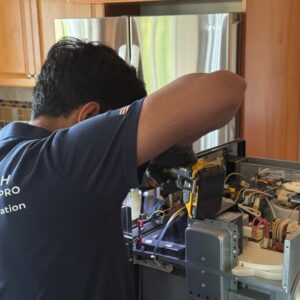
This is the one appliance where we ask you not to experiment. If your microwave runs but the food stays cold, the cause is usually the magnetron, the capacitor, or the diode. All of those sit behind the casing, and the capacitor can hold a dangerous charge even when the unit is unplugged.
So for GE microwave repair or GE microwave oven repair, our advice is simple: don’t open it. If you notice sparks, stop using it right away. Sometimes it’s only a burned waveguide cover, which is a cheap fix, but you want someone qualified to look at it.
A turntable that won’t spin is the exception. Check that the roller ring and glass tray are seated properly before you assume something is broken.
If you’ve been wondering whether General Electric microwave oven repair is worth the money, here’s an honest answer. For a built-in or over-the-range model, it usually is, since replacing one means dealing with the cabinet and venting. For a cheap countertop unit, a replacement can sometimes make more sense.
Refrigerator problems:
A fridge that isn’t cooling is the most urgent repair of all, because your food is on the clock. The usual suspects are dirty condenser coils, a stuck evaporator fan, or a failed start relay. If the freezer is fine but the fresh food section is warm, there’s often an airflow or defrost problem.
Vacuum the coils (check your manual for where they are), make sure nothing is blocking the vents inside, and confirm the temperature setting hasn’t been bumped. If it’s still warm after a few hours, move the perishables to a cooler and call for GE refrigerator repair. Don’t wait a couple of days to see if it improves. It rarely does.
Water on the floor is usually a clogged defrost drain or a loose water line, and a quiet ice maker is often just a frozen fill tube. Both are quick fixes when caught early.
Should you repair it or replace it?
It’s the question we hear most. As a rough guide, if your appliance is under ten years old and the repair costs less than half of a new one, repair it. If it’s older, keeps breaking down, or needs a major part like a compressor, replacing may be the smarter move.
We’ll give you a straight answer either way. If a repair doesn’t make sense, we’ll say so.